
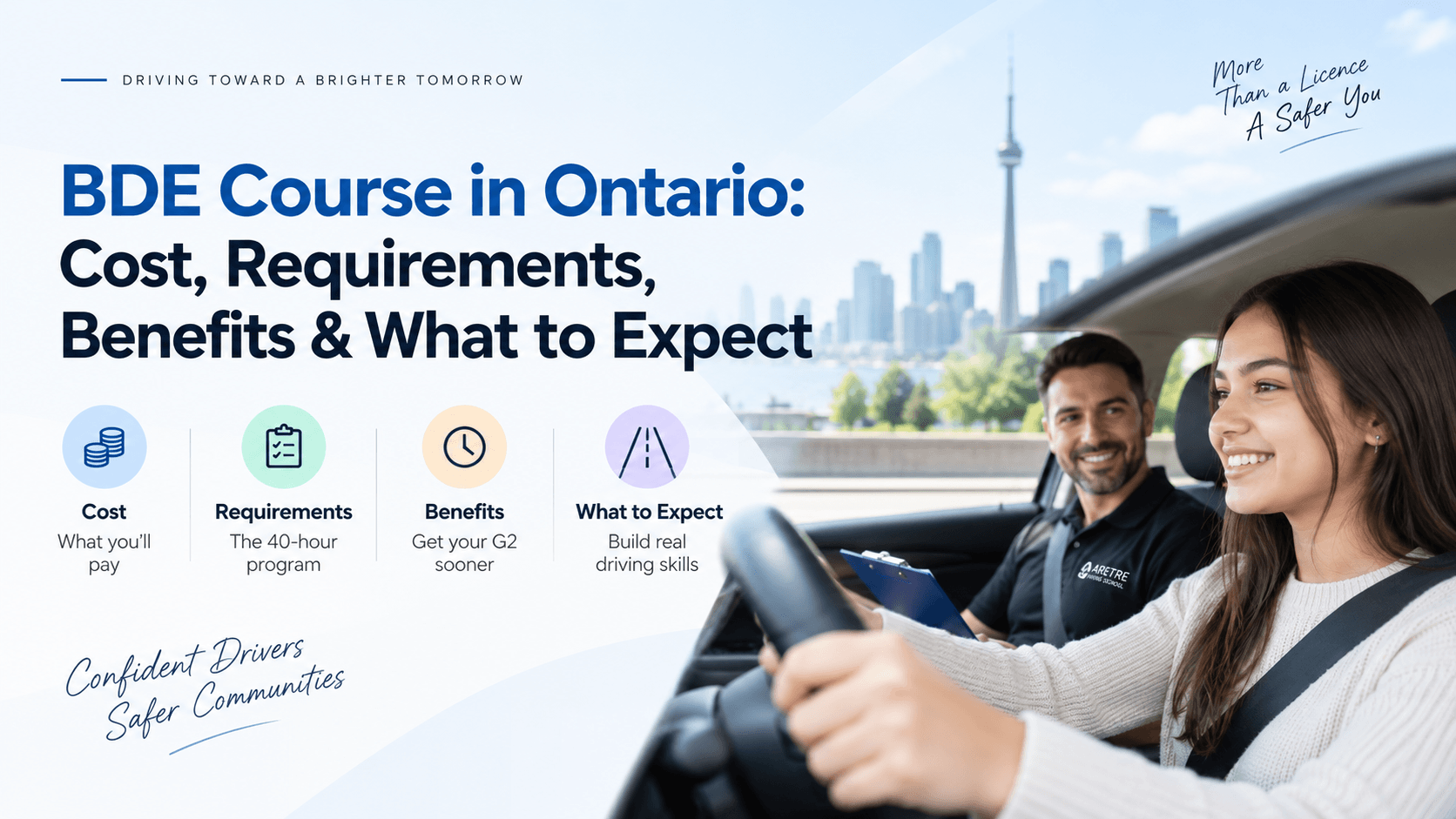
BDE Course in Ontario: Cost, Requirements, Benefits & What to Expect
You passed your G1. Now comes the part that actually teaches you how to drive confidently on Ontario roads.
If you’re researching driving schools, you’ve probably come across the term BDE course. You may also be wondering whether you really need one, what the 40-hour program involves, how much it costs, and whether it can actually help you get your G2 sooner.
BDE stands for Beginner Driver Education. In Ontario, government-approved BDE programs combine theory, professional in-car instruction and additional flexible training to help new drivers build safer driving habits.
Completing an approved program comes with another important benefit: you can become eligible to take your G1 exit road test after 8 months instead of waiting the standard 12 months.
Here’s what you should know before choosing a BDE course in Ontario.
What Is a BDE Course in Ontario?
Beginner Driver Education is a driver-training program offered by driving schools approved by Ontario’s Ministry of Transportation (MTO).
It goes beyond practising enough manoeuvres to get through a road test.
A BDE program is designed to develop the knowledge, decision-making skills and behind-the-wheel experience new drivers need for everyday situations—including busy intersections, changing traffic conditions, poor weather and unexpected hazards.
Ontario requires an approved BDE program to include at least 40 hours of instruction.
That training is divided into three parts.
20 Hours of Classroom or Digital Instruction
The first component covers driving theory.
Depending on the approved program, this instruction can be delivered digitally or in person.
Topics can include:
- Ontario traffic laws and rules of the road
- Signs, signals and right-of-way
- Safe following distances
- Hazard recognition
- Distracted driving
- Risk management
- Sharing the road
- Driving in adverse conditions
- Defensive-driving principles
Online instruction can be particularly convenient for students balancing school, work or other responsibilities because it allows the theory component to fit more easily around their schedule.
You can learn more about Aretre’s in-class and digital instruction options.
10 Hours of In-Car Instruction
Every approved BDE program includes at least 10 hours of in-vehicle instruction with a licensed instructor.
This is where theory becomes practical experience.
Depending on your skill level and progress, lessons can cover areas such as:
- Steering and vehicle control
- Turns and intersections
- Lane changes
- Parking
- Three-point turns
- Observation habits
- Speed and space management
- Hazard awareness
- Defensive driving
- Road-test preparation
Professional instruction can also identify habits you may not notice when practising with family or friends.
See what to expect from Aretre’s in-car driving instruction.
10 Hours of Flexible Instruction
The final 10 hours are known as flexible instruction.
Depending on the approved program, these hours may include additional classroom instruction, digital instruction, in-vehicle training, simulator instruction or home-link activities.
Together, the three components make up the minimum 40-hour BDE program:
| Training component | Minimum hours |
|---|---|
| Classroom/digital instruction | 20 hours |
| In-vehicle instruction | 10 hours |
| Flexible instruction | 10 hours |
| Total | 40 hours |
How Much Does a BDE Course Cost in Ontario?
There isn’t one province-wide price for BDE courses. Individual driving schools set their own prices, and costs vary based on what’s included.
When comparing packages, don’t look at the advertised price alone.
Check how many in-car hours you receive, whether the program is MTO-approved, whether road-test preparation is included, whether you can use an instructor’s vehicle for your test, and whether there are additional charges.
Aretre Driving School, for example, currently offers several BDE options.
The Bronze Package is $565 + HST and includes 20 hours of digital online learning, 10 hours of online home-link learning and 10 hours of in-car lessons, along with MTO certification and road-test preparation.
The Platinum Package is $869 + HST and includes the BDE components plus 15 hours of in-car lessons and use of the instructor’s vehicle for a local Etobicoke road test.
Prices and package inclusions can change, so check the current Aretre driving lesson packages and pricing before enrolling.
If you’re comparing the overall cost of learning to drive, our guide to driving lesson costs in Toronto explains what affects lesson pricing.
The Biggest BDE Benefit: Take Your G2 Road Test 4 Months Earlier
For many new drivers, this is one of the most valuable reasons to complete BDE.
Normally, a new G1 driver must remain at Level One for 12 months before becoming eligible for the G1 exit road test.
Successfully completing a government-approved BDE program can reduce that period to 8 months.
That’s four months sooner.
For a student who wants to drive independently to university, a new employee commuting to work, or anyone tired of coordinating every practice session with an accompanying driver, those four months can make a meaningful difference.
Keep in mind that finishing BDE doesn’t automatically give you a G2 licence. You still need to meet Ontario’s requirements, book your road test and pass it.
If you’re approaching that stage, read our guide on booking your G2 road test in Ontario.
Can a BDE Course Lower Your Car Insurance?
Potentially—but don’t assume a specific discount.
After you successfully complete a government-approved BDE program, the driving school certifies your completion electronically and your student driver record is updated through the Ministry of Transportation.
If you need proof of completion, you can order a Driver’s Licence History, which includes Ontario BDE course completion.
Some insurance providers may offer graduates a discount or recognize approved driver training when calculating premiums.
However, completing BDE does not guarantee an insurance discount, and there is no universal percentage that applies to every Ontario driver.
Your premium can depend on factors such as your insurer, age, vehicle, location, driving history and policy.
Before choosing BDE specifically for insurance savings, contact your insurance provider and ask:
“Do you offer a premium reduction for completing an Ontario government-approved Beginner Driver Education program, and what documentation do you require?”
That gives you a much more reliable estimate than assuming a particular percentage.
For a deeper explanation, read what MTO-approved training really means for your licence and insurance.
What Do You Actually Learn in BDE?
The real value of BDE isn’t just reaching your G2 test sooner.
It’s learning how to make better decisions when nobody is sitting beside you telling you what to do.
Hazard Recognition
New drivers often concentrate heavily on what’s directly in front of the vehicle.
Good defensive-driving instruction teaches you to look farther ahead, regularly check your mirrors and identify potential hazards before they become immediate problems.
Space Management
You need enough space to react when something unexpected happens.
BDE training reinforces safe following distances, positioning and ways to maintain an escape route when traffic conditions change.
Intersections
Intersections can be challenging for beginners because you’re processing several things at once: pedestrians, traffic signals, approaching vehicles, turning traffic and right-of-way.
Professional instruction helps turn those individual checks into consistent habits.
Driving in Difficult Conditions
Ontario driving isn’t always dry pavement and clear skies.
Driver education also addresses risk management and driving in adverse conditions so you’re better prepared to adjust your speed, following distance and decisions when conditions deteriorate.
Defensive Driving
One of the biggest changes between a beginner and a confident driver is learning to anticipate mistakes made by other road users.
Instead of simply reacting to what happens, defensive drivers continuously scan, predict potential conflicts and create enough time and space to respond safely.
BDE Course vs. Practising With a Parent: Which Is Better?
It doesn’t have to be one or the other.
Professional BDE instruction gives you structured training from a licensed instructor. Practice with an experienced accompanying driver gives you additional time behind the wheel.
For many beginners, combining both works well.
Your instructor can teach you the technique, correct problems and explain what to practise. You can then use supervised practice between lessons to reinforce those skills.
If you don’t have regular access to a vehicle for practice—or you’re particularly nervous behind the wheel—a package with additional professional in-car hours may make more sense.
How to Choose a BDE Driving School in Ontario
Before paying for a course, confirm that the school is government-approved to provide Beginner Driver Education.
Then look beyond approval.
Ask what’s included in the advertised price. Find out how scheduling works, how much actual in-car instruction you’ll receive, whether you’ll work with licensed instructors, and whether additional lessons are available if you need them.
You should also consider whether the instructor’s teaching style fits you.
A nervous first-time driver may need something very different from someone who has already accumulated substantial supervised practice.
Our guide on how to choose a driving school in Toronto walks through the questions worth asking before enrolling.
You can also read Aretre student testimonials to see what previous students say about their training experience.
Is a BDE Course Worth It?
If your only goal is to get as much inexpensive driving practice as possible, individual lessons and supervised practice may initially look cheaper.
But BDE provides benefits that casual practice alone doesn’t.
You receive a structured government-approved curriculum, professional in-car instruction and official completion recorded with the Ministry. Successful completion can also reduce your G1 waiting period from 12 months to 8 months and may qualify you for insurance savings depending on your provider.
Most importantly, the goal is to develop driving habits you’ll use long after your road test is over.
That is where the value of good driver education matters most.
Frequently Asked Questions About BDE Courses in Ontario
What does BDE stand for?
BDE stands for Beginner Driver Education. It is Ontario’s government-approved driver education program for beginner drivers.
How many hours is a BDE course in Ontario?
An approved BDE program requires at least 40 hours of instruction: 20 hours of classroom or digital instruction, 10 hours of in-vehicle instruction and 10 hours of flexible instruction.
Can I take the BDE classroom portion online?
Approved programs may provide the classroom component digitally or in person. Check with the driving school to confirm how its specific program is delivered.
Does BDE reduce the G1 waiting period?
Yes. Successful completion of a government-approved driver education course can reduce the Level One waiting period from 12 months to 8 months, allowing you to take your first road test four months sooner.
Does BDE guarantee an insurance discount?
No. Your insurance provider may offer savings for completing an approved BDE program, but Ontario does not guarantee a discount. Ask your insurer what applies to your policy.
How do I prove I completed BDE?
After successful completion, your driving school certifies you electronically and your student driver record is updated. If you need formal proof, you can order a Driver’s Licence History, which includes Ontario BDE completion.
How long do I have to complete the BDE program?
Ontario requires students to complete the approved BDE program within one year from the start of classroom instruction.
How do I know whether a driving school is MTO-approved?
Check Ontario’s official list of government-approved driving schools before registering. Don’t rely solely on the wording used in an advertisement or website.
Start Your BDE Course in Toronto
Learning to drive isn’t only about getting through the G2 test. It’s about becoming comfortable making safe decisions when you’re eventually driving on your own.
Aretre Driving School offers MTO-approved Beginner Driver Education with flexible digital learning and professional in-car instruction for Toronto and Etobicoke drivers.
Compare the available BDE packages to find the amount of in-car training that fits your experience and confidence level.
Already know which option you want?
Book your driving course with Aretre Driving School and start working toward your G2.