
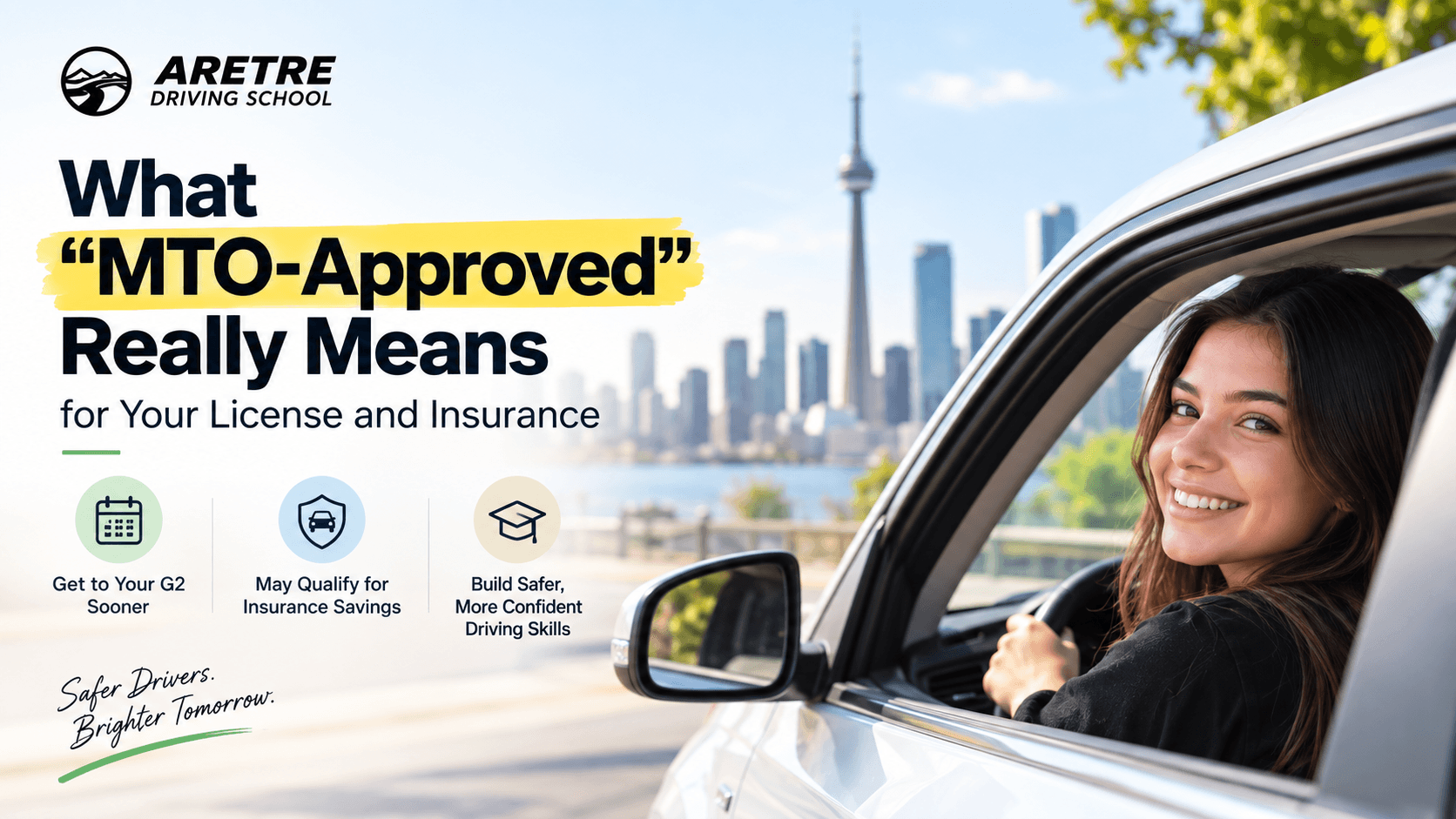
What “MTO-Approved” Really Means for Your License and Insurance
If you’re comparing driving schools in Toronto, you’ve probably seen the words “MTO-approved” more than once.
But what does MTO-approved actually mean? And does choosing an approved driving school make a meaningful difference when you’re working toward your G2?
For new Ontario drivers, it can.
Completing an MTO-approved Beginner Driver Education (BDE) course can reduce the minimum time you need to stay at the G1 level before taking your G2 road test. It may also help you qualify for savings on auto insurance, depending on your insurance provider.
More importantly, an approved BDE program gives you structured training designed to prepare you for more than simply passing a road test.
Here’s what you should know before choosing a driving school.
What Does MTO-Approved Mean in Ontario?
MTO stands for the Ministry of Transportation of Ontario.
An MTO-approved Beginner Driver Education program must meet provincial requirements for course content, instruction, administration and training.
That distinction matters because taking a few private driving lessons is not the same thing as completing an approved BDE program.
An approved BDE course includes a minimum of 40 hours of instruction, consisting of:
- At least 20 hours of classroom or digital instruction
- At least 10 hours of in-vehicle instruction
- 10 hours of flexible instruction
Flexible instruction can include additional classroom or digital learning, in-vehicle instruction, driving simulation and other approved learning activities.
The program also needs to be completed within the required timeframe.
At Aretre Driving School, students can combine structured theory education with practical in-car driving instruction to develop the knowledge and behind-the-wheel skills needed for Ontario roads.
MTO-Approved Course vs. Regular Driving Lessons
This is where many new drivers get confused.
You might find an instructor offering individual lessons at an attractive hourly price. Those lessons may help you practise driving, but that doesn’t automatically mean you’re completing an MTO-approved BDE program.
The difference matters.
| MTO-Approved BDE Course | Individual Driving Lessons | |
|---|---|---|
| Structured BDE curriculum | Yes | Not necessarily |
| Minimum 40-hour program | Yes | No |
| Minimum 10 hours in-car | Yes | Depends on lessons purchased |
| BDE completion recorded by MTO | Yes, after successful completion | No |
| G2 eligibility after 8 months | Yes, when requirements are met | Normally 12 months |
| Potential insurance benefit | May qualify | Not a BDE benefit |
If you’re comparing your options primarily by price, make sure you’re comparing the same type of driver training.
Our guide to choosing a driving school in Toronto explains other factors worth checking before you register.
The Biggest Licence Benefit: Take Your G2 Road Test Sooner
For many G1 drivers, this is the most immediate advantage of completing an approved BDE course.
Under Ontario’s graduated licensing system, a new driver generally needs to remain at the G1 level for 12 months before becoming eligible to take the G1 exit road test for a G2 licence.
Successfully completing an approved Beginner Driver Education course can reduce that period to 8 months.
That means you can become eligible 4 months earlier.
Four months can make a meaningful difference when you’re waiting for more driving independence.
For example, getting your G2 sooner may make it easier to:
- Commute to work or school
- Get to university or college
- Attend appointments independently
- Help with family responsibilities
- Build more independent driving experience
Keep in mind that completing BDE doesn’t automatically give you a G2 licence.
You still need to meet Ontario’s licensing requirements and pass the G2 road test.
When you’re approaching your eligibility date, read our guide on how to book your G2 road test in Ontario.
Can an MTO-Approved Driving Course Lower Your Insurance?
Potentially — but this benefit needs to be understood correctly.
After you successfully complete an approved BDE program, your completion is recorded in your Ontario driver record.
You can obtain a Driver’s Licence History (DLH) showing your BDE completion. This document can be used as proof when speaking with an insurance company.
Some insurers may offer a lower premium to drivers who have successfully completed an approved BDE course.
However, an insurance discount is not guaranteed.
Your actual insurance premium can depend on many factors, including:
- Your age and driving experience
- Where you live
- The vehicle being insured
- Your driving history
- Your coverage and deductible
- The insurance company
- Other drivers listed on the policy
That’s why you shouldn’t choose a driving course based on a promised percentage discount.
Instead, contact your insurance company or broker and ask:
“Do you offer a discount or preferred rate for completing an Ontario MTO-approved Beginner Driver Education program?”
That gives you an answer based on your actual insurer and circumstances.
How Do You Prove You Completed an MTO-Approved Course?
Another common misconception is that your driving school simply hands you a paper certificate that you take to your insurer.
Ontario now records successful BDE completion electronically.
After you’ve successfully completed your approved program, the driving school certifies your completion and your student driver record is updated through the Ministry of Transportation.
If you need official proof, you can order your Driver’s Licence History.
The DLH includes your Ontario Beginner Driver Education course completion information.
This is different from a standard three-year driver record, which does not include BDE course completion.
What Do You Actually Learn in an MTO-Approved BDE Course?
Getting to your G2 sooner is useful, but good driver education shouldn’t be about finding the fastest possible route to a road test.
You’re learning how to handle a vehicle in real traffic.
And driving in Toronto can quickly become more complicated than what happens during a road test.
Think about:
- Heavy traffic on major GTA roads
- Cyclists beside you when you’re turning
- Pedestrians entering intersections unexpectedly
- Highway merging
- Aggressive drivers
- Snow and ice
- Reduced visibility
- Night driving
- Construction zones
- Sudden lane changes
Approved BDE training goes beyond memorizing a test route.
Students learn topics such as risk perception and management, strategic driving techniques, distraction avoidance, freeway driving, night driving and driving in adverse conditions.
Then your in-car driving lessons give you the opportunity to apply those concepts behind the wheel.
Is an MTO-Approved Driving Course Worth It?
For many new Ontario drivers, the value comes from several benefits working together rather than one single advantage.
You receive structured driver education, practical in-car training and the ability to become eligible for your G2 road test four months sooner.
You may also qualify for insurance savings, depending on your insurer.
But there’s another benefit that’s harder to put a dollar value on:
confidence.
New drivers commonly struggle with situations such as:
- Changing lanes in traffic
- Making left turns at busy intersections
- Judging gaps between vehicles
- Parking
- Merging
- Driving at higher speeds
- Reacting calmly when another driver makes a mistake
Structured training gives you time to practise these situations with an instructor before you’re expected to manage them independently.
If nervousness is one of your biggest concerns, choosing the right driving instructor in Toronto can be just as important as choosing the right package.
What Should You Check Before Choosing a Driving School?
Don’t assume that every driving school offering lessons provides an approved BDE course.
Before paying, confirm what you’re actually purchasing.
Ask:
- Is the school currently approved to provide Ontario’s Beginner Driver Education program?
- Does this specific package qualify as the complete BDE program?
- How many hours of in-car training are included?
- Are there additional certification or administrative fees?
- How is the theory portion delivered?
- How quickly can I schedule my in-car lessons?
- What happens after I complete all course requirements?
- Is road-test preparation or vehicle use included?
You can also review the school’s student testimonials and compare its course structure, instructor experience and scheduling flexibility.
For a more detailed checklist, see how to choose a driving school in Toronto.
MTO-Approved Driving Lessons in Toronto with Aretre Driving School
If you’re looking for structured training as you work toward your G2, Aretre Driving School offers driver education designed to combine theory with practical behind-the-wheel experience.
Instead of focusing only on what you need to do on test day, the goal is to help you become comfortable making decisions in everyday GTA driving situations.
Depending on the program you choose, your training can include online learning and one-on-one in-car instruction.
You can review the current driving lesson packages to compare your options and choose the amount of training that fits your experience and confidence level.
Not sure which option makes sense? Contact Aretre Driving School before registering and ask which program best matches where you are in the licensing process.
Frequently Asked Questions
What does MTO-approved driving school mean?
It means the school is authorized to provide a Beginner Driver Education program that meets requirements established by Ontario’s Ministry of Transportation. Approved BDE programs include classroom or digital education, in-vehicle training and flexible instruction.
How many hours is an MTO-approved driving course?
An approved Beginner Driver Education course requires at least 40 hours of training: at least 20 hours of classroom or digital instruction, at least 10 hours of in-vehicle instruction and 10 hours of flexible instruction.
Can I get my G2 after 8 months with driving school?
If you successfully complete an approved BDE course and meet the applicable Ontario licensing requirements, your minimum G1 period can be reduced from 12 months to 8 months. You must still pass your road test to obtain your G2.
Does an MTO-approved driving school lower insurance?
Completing an approved BDE course may help you qualify for insurance savings, but discounts are determined by individual insurance companies and are not guaranteed. Ask your insurer or broker what applies to your policy.
How do I prove I completed driver education?
After successful completion, the school certifies you electronically and your record is updated through the Ministry of Transportation. You can order a Driver’s Licence History that shows your Ontario BDE course completion.
Is MTO-approved driving school mandatory in Ontario?
No. Completing an approved BDE course isn’t required simply to take the G2 road test. However, successful completion can reduce the minimum G1 period from 12 months to 8 months and may provide insurance benefits.
Start Building Your Driving Confidence
The real question isn’t simply whether an MTO-approved course helps you reach your G2 sooner.
It’s whether you want to arrive at your road test with enough training to feel comfortable making decisions on your own.
The four-month reduction in G1 waiting time is valuable. Potential insurance savings can be valuable too. But learning how to recognize hazards, control the vehicle confidently and make safer decisions will matter every time you drive after the test.
Ready to start?
Explore Aretre Driving School’s driving lesson packages or book your driving lessons and start working toward your G2 with structured, professional training.